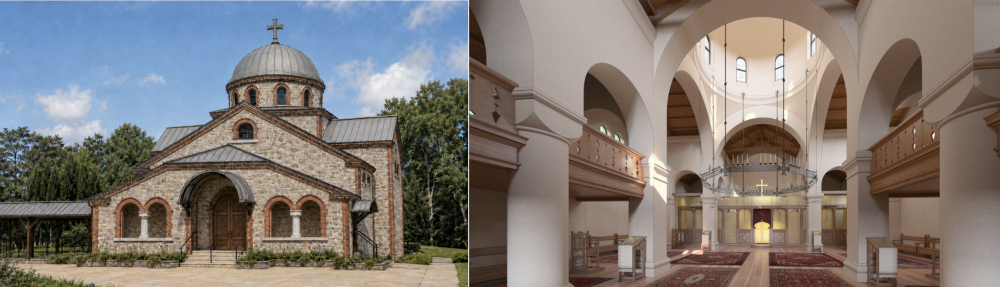
Glory to Jesus Christ! Here is the next post of the Holy Ascension Building Project Newsletter. (July 2026)
Current Status:
With people traveling and students away in these summer months, the space situation we have on Sunday mornings has been temporarily upgraded from unbearably crowded to merely uncomfortably crowded, Glory to God! Either way, the need for a new space remains hard to forget about for long.
Concerning finances and builders, the needle hasn’t moved much since the details I shared in the previous post. So we continue to pray and wait on God’s timing for us. We would be very appreciative if you would join us in prayer. Here is a petition you could use, it’s the prayer that we are using in our services:
Again we pray that the Lord our God will bless the construction and successful completion of a new church building for this community, just as He called forth the artisans for the building of the tabernacle. That He will bless the hands of all who labor on this project, and inspire benefactors to provide all that is needed for its swift and beautiful realization, let us ask of the Lord.
Meanwhile we are chipping away at smaller projects to prepare the property and the existing building for our future church building. We have also had some success with some smaller fund-raising efforts such as holding garage sales.
Building Project Narrative:
- Lord, I have loved the beauty of Your house, and the place where Your glory dwells. (Psalm 26)
- Sanctify those who love the beauty of Your house. (Prayer of the 2nd Antiphon.)
Like all other aspects of Christian art, a church building should point beyond itself to God, such that a worshipper approaching and standing in that space will find himself drawn to God, the final meaning and purpose of everything we do. In a word, it must be beautiful.
That may be self-evidently true when we consider iconography, vestments, music, etc, but when it comes to architecture it’s easy to forget its true purpose and instead lean too heavily into utilitarian considerations or personal preferences. Putting transcendent beauty first requires a firm and unwavering intention until you’ve tasted it enough. But then it becomes a sort of divine intoxication that you’ll want to infiltrate every detail.
If you’re new to all of this, you will find no better introduction than this wonderful lecture by Archbishop Alexei on beauty in church architecture. For a much deeper dive, read The Ethics of Beauty by Timothy Patitsas. In his chapter “Thy Mystical Architect”, he points us to a lesser-known but very deep-thinking 20th architect, Christopher Alexander, who wrote at length on how a building’s patterns shape and interact with its inhabitants. His main work on this is called A Timeless Way of Building, and a second book, A Pattern Language, gives hundreds of examples. Patitsas summarizes:
The Timeless Way starts with a kind of riddle: in the buildings and places that we most love and that feel to us the most alive, there is some quality that we cannot quite capture in words. Something “extra” is going on there which we recognize as very important, although we cannot name it.
Alexander then deepens the riddle: what if the undefinability of this quality is the result, not of its vagueness but of its astounding specificity? This nameless quality is TOO precise for words, Alexander says. He refers to characteristic of good places as “the quality without a name,” and he goes on to argue that the search for this quality is the fundamental search not only in building and in the arts, but in every human life. We are all governed by an eros for something ineffable which, when we find it, will give order and meaning to our souls and lives.
Within the opening few pages of his book, in just a few short words, Christopher Alexander prompts you to recognize that you do know this quality that he is talking about, even if it is quite mysterious and can hardly be defined in any analytical way. And you must admit that this quality is so important that it, and not intellectual theories, has the right to judge art. . . .
The Patterns of The Timeless Way of Building are much like the Platonic Forms. Or, in the terms of St. Maximos Confessor, they are the logoi, the archetypal ways that we participate in the Logos, in Christ. The patterns can carry a certain glory, can disclose this Quality Without a Name, because somehow they are a preliminary mode by which Christ makes his life available to creation – when you see a building, a room, or a city that possesses this ineffable character, you really do sense that this Quality is of life or death importance. . . .
Christopher Alexander stresses that an experience of actual Beauty is not merely a matter of your private opinion, prejudice, or emotion. I think this is because when you meet real Beauty, you are in a real way partaking of Christ, who is the Logos – the Logos who is the trans-rational ground of reason, and therefore the aesthetic sense is not something which is opposed to reason.
Reading and studying these forms and how they appear in buildings greatly enhances one’s appreciation of the divine through them. On the downside, it becomes impossible to NOT see inauthentic structures when they are pretending to be something they are not. Likewise, reading Alexander’s books gives you a sort of x-ray vision: you start to see the patterns of how we interact with our environment, which can be depressing when the pattern is negative, but can give amazing insight when you’re trying to design something to solve the problem.
Although most of his patterns are not directly about churches, many of them are applicable. As we discussed these patterns during the early planning of the new temple, it became clear what sort of dysfunctional patterns were at work in our parish already, which we have started to address as best as our current building allows. But more importantly, seeing how these patterns work gave us a framework and a language to make design choices for the new church. You can’t just say that this way is better than that way, you have to ask, what is the pattern in this case, and how does it serve beauty? What makes this pattern more or less life-giving?
Interacting with church patterns begins from the moment you approach the church. What will you see and where will you park? What will direct you to the building and how will you transition into that holy space? How do you enter and where will you stand? How will the experience of the building and the people around you shape your prayer? How will children, parents, and visitors experience it? How will the transition from church to coffee hour work? There are already distinct patterns in everything we’re doing: venerating icons, lighting candles, communion lines, singing, etc. If we get the patterns in the design right, no one would need signs or directions, you would just know what to do. In theory one could write a book using the same structure that Alexander did, but fill it instead with specific Orthodox Church patterns covering topics such as those above.
So let’s begin that book by looking at some of these patterns and how to best solve them with good design decisions.
Fr Joshua.